

Navigation ... |

|

|
Scientific Writing ... |

|

|

|

|

|

|

|

|

|

|

|

|

|

|

|
Other Writing ... |

|

|

|

|
Reference details
| Author(s) | Year | Title | Reference | View/Download |
|---|---|---|---|---|
Les Hatton | 2011c1 | 1946-2010: Worldwide Hurricane Activity | WEB | HurricaneActivity1946-2010.pdf |
Synopsis and invited feedback
Peer review is important and acquiring competent reviewers is becoming a major problem for the journals today so I will be very happy to include constructive comment (positive or negative) with acknowledgement. If I am not competent to judge your commentary I will try and find somebody who is.
If you would like to provide feedback just e-mail me here.
| Synopsis | Invited Feedback | Importance (/10, author rated :-) ) |
|---|---|---|
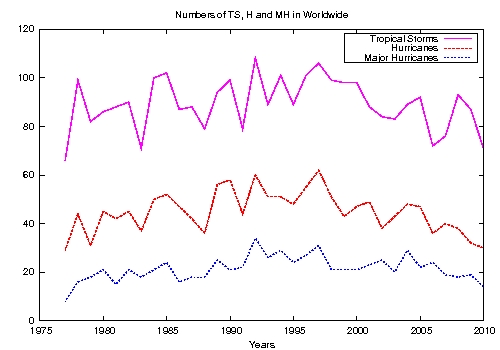
| This is an update of the paper I wrote a year ago showing that Hurricane Data did not support the widely advertised view that hurricanes are getting stronger.
Here I update to the period 1946-2010. The previous conclusions are unchanged with 2010 being a particularly quiet year continuing an apparent decline in activity. World-wide, the data shows a distinct convex upwards trend with an approximate half-period of around 35 years and a peak of activity in the mid-1990s. Its really interesting and if this is indicative of the IPCC's quoted recent rising trend, I clearly need to change my optician. The data is taken directly from the Unisys site shown below. All I have done is graph various bits of it so my grateful thanks to them. In the interests of open pedagogic research, I have also included a link below to the updated spreadsheet so you can plot and analyse it yourselves. | None yet | 8 |
Related links
| Related papers and links |
|---|
http://www.leshatton.org/Documents/Data_Hurricanes_1946-2010.zip |
Auto-generated: $Revision: 1.63 $, $Date: 2020/01/25 16:18:09 $, Copyright Les Hatton 2001-